

This species is found in Hong Kong and much of China, Taiwan, Korea, Japan and even Siberia. In Hong Kong, it is in fact locally widespread and individual wasps can be found in quite a wide range of habitats, including urban areas in less congested or polluted regions. However, as a result of having the smallest colonies of all local hornets, it appears less common than it actually is. Nests are more often found in the countryside, although from time to time they may be built in urban areas. Individual workers are fairly secretive and timid, preferring to fly close to objects in search of prey and less often in the open.
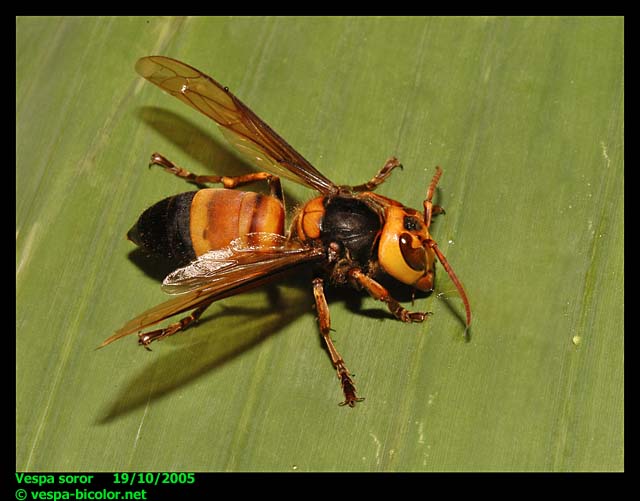
This species is also similar in appearance to Vespa soror; in fact, I considered all such wasps in Hong Kong to be Vespa ducalis until I noticed substantial differences in structure and behaviour and then sent specimens for expert verification. Vespa ducalis is smaller and more slender than Vespa soror; it has a normal sized head (not greatly widened behind the eyes), and the stripes of various colours on the abdomen are darker and far more contrasting than those on Vespa soror (shown below). It is important to be able to differentiate the two species in the field, for both species differ greatly in temperament and it would be risky to mistake a nest of Vespa soror for that of the gentle Vespa ducalis!
This species was formerly considered a subspecies of Vespa tropica. Several recent papers have been written on these two species, confirming Vespa ducalis as a valid separate species. Structural characteristics aside, it is totally different from Vespa tropica in appearance and biology. The two species also have very little geographical overlap, and in fact, Hong Kong is one of the few places in which both occur together. It should be noted that past research on Vespa tropica (sometimes listed as subspecies "Vespa tropica pulchra") in Japan actually concerns Vespa ducalis.
This species specializes in attacking the nests of Polistines (paper wasps) and capturing the larvae to feed their own larvae. It is said to be almost exclusive in choice of prey, and very rarely takes other prey. It is said that a colony of Vespa ducalis needs at least 120 to 150 colonies of Polistine wasps to survive! Vespa ducalis, like its near relative Vespa tropica, usually hunts singly among trees and shrubs in search of such wasp nests. When it locates one, it will land on the nest, immediately proceeding to pull out larvae and pupae, often tearing the cells in the process. The original occupants usually hide in a corner or flee the nest, never fighting back! Like Vespa tropica, and unlike Vespa soror, this species seldom kills the original occupants, being content to drive them to one side so it can capture the larvae without resistance.
The nest of Vespa ducalis is usually underground or in a crevice. Due to the location, the nest is seldom seen. However, nests are sometimes built inside visible locations in old village houses or even within apartments in Hong Kong. If excavated or exposed, the nest may look like an overturned bowl, with an open bottom (as opposed to the completely sealed nests of most aerial hornets). The nest envelope is laminar (comprising of distinct, broad individual layers) and very brittle. However, the width of the envelope on larger nests often constricts at the bottom of a comb and then widens again at the top of the next comb, giving the nest a strange "gourd-like", "peanut" or "bell" shape. The photos below are of a nest I relocated to my apartment in 2009, giving a general idea of how the envelope is constricted at the base of each comb and then widens again.


This species supposedly has the smallest colony sizes of any hornet. Nests usually have a maximum of 3 combs and usually not more than a hundred adult wasps at any one time; in fact, less than 50 to 60 individuals at the height of the season is more usual. The photos below show something not commonly seen; a nest of Vespa ducalis not built in a cavity, but in an exposed location under an overhead bridge. This was truly a great opportunity to watch these wasps, and I revisited the site for many weeks; the two photos show it in an early stage and then towards completion. However, since then I have seen and heard of several other instances of such behaviour; it seems that besides underground, this species does sometimes nest under large overhead bridges in Hong Kong.


In Hong Kong, this species has an extremely short life cycle, with queens starting their nests only in mid-May, and colonies starting to die off in September.
The exceptionally mild temperament of Vespa ducalis is something I often get carried away and long-winded in discussion, because even after extensive personal experience I find it hard to believe that such tolerance to human disturbance exists among any species of social wasp! It is totally lacking in any aggression and showing little defensive behaviour even if the nest is disturbed. From personal experience, I learnt that individuals of this species will react in three different ways to being disturbed on the nest: either ignoring the disturbance, latching on and biting lightly or moving away to avoid the disturbance. No other social wasp in Hong Kong will tolerate such intrusion into its nest! In August 2006, I relocated the nest built under the overhead bridge pictured above, upon finding out that someone had already reported the nest to the authorities and it would soon be destroyed. By then, it had around 30 or 40 wasps and 3 combs. When the nest was brought down in a net, the workers that escaped made no attempt to attack, but simply tried to return to the nest. Also, in an attempt to photograph the nest below, which was built in some bushes, I trimmed the bushes with a pair of shears in order to be able to photograph the nest. Since there were no workers on the envelope at that point, I used a stick to brush the envelope in order to get some workers out so I could photograph them on the nest. Only a few wasps emerged; they walked about the envelope, one of them gave the stick a lazy bite, but that was all, and they disappeared into the nest almost as quickly as they emerged.


In 2009, Vespa ducalis was exceptionally abundant and plentiful throughout Hong Kong. There were more nests and wasps in the countryside and even in urban areas than usual. Thus I got more hands-on experience with this species than ever before. First of all, I found a nest built underground, at the base of a tree stump, in a conspicuous location. Therefore, I relocated this nest to my home for observation (this is the nest which built an envelope in a bell-like shape in the photos above. I will write a more detailed report on this nest, the relocation and my observations later). When I dug out the nest, the wasps swarmed around frantically, but made no attempt to attack. In fact, they avoided my net and fled when I advanced on them - I had a hard time catching all of them because of this! I spent a good five months sitting next to this nest in my home, mostly observing them, but sometimes spreading honey on my hands and tempting all the wasps to climb on, or touching the envelope. Sometimes I even poked the wasps with forceps, a small flashlight or bamboo skewers, or carried the entire nylon mesh cage they were housed in, in front of visitors who were always shocked that such fearsome-looking hornets could be so harmless! Of course I didn't do this all the time, only occasionally to demonstrate to anyone who cared to watch. The video below shows how this species reacts to disturbance by either ignoring, moving away or biting in a half-hearted manner. The next video shows how I often hand-fed this colony.
The videos above require Windows Media Player to view. If you don't have this program or the videos don't load, click the links below for the relevant videos on Youtube. Note that the Youtube versions are slightly poorer in quality. Links open in a new window.
In July 2009, my friend and I found this small nest in an abandoned village house, affixed to a wooden beam on the ceiling. This was the very first time my friend plucked up the courage to touch the nest while I took these photos. Previously, even knowing how unaggressive this species is, we still could not summon the courage to touch a nest of these impressive hornets without any protection!


Just a few days later, we found an exceptionally large nest in another house a short distance away. This nest was built inside an old cabinet, eventually reached a larger size than usual, with four combs, and probably contained more than a hundred wasps at its peak. We visited this nest frequently and observed it throughout the season. During one occasion, we jumped up and down and shook the cupboard vigorously, and while many of the wasps swarmed out, most fled through the window, only returning some minutes later! One individual showed a little more defensive behaviour and made a few darts at my shoe when I kicked out at her, but these were obviously quite slow and half-hearted and she did not at all attempt to latch on and sting, it was as though it was all a bluff. And the following photos and video of the way my friend placed his hand on this exceptionally large nest confirm the fact that this species may well be Asia's most gentle and harmless social wasp.


(If you do not have Windows Media Player or the video above does not load properly, click here for the lower quality Youtube version.)
My experience with Vespa ducalis clearly shows it to be incredibly unaggressive and exceptionally tolerant of disturbance by any standard, and especially for a hornet. Still, it can give a painful sting (the only time I have been stung was by accidentally squeezing the leg of one), so it would be wise not to deliberately disturb a nest. It may occasionally nest inside houses, in structures such as cabinets or bookshelves. However, this species is certainly not a major threat to us and should be left unharmed whenever possible.