
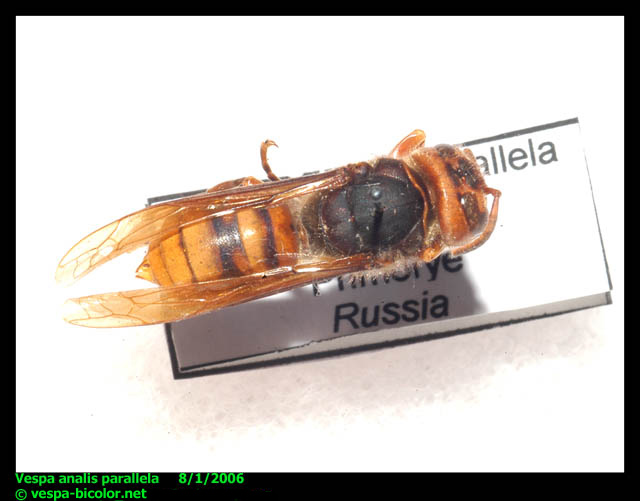
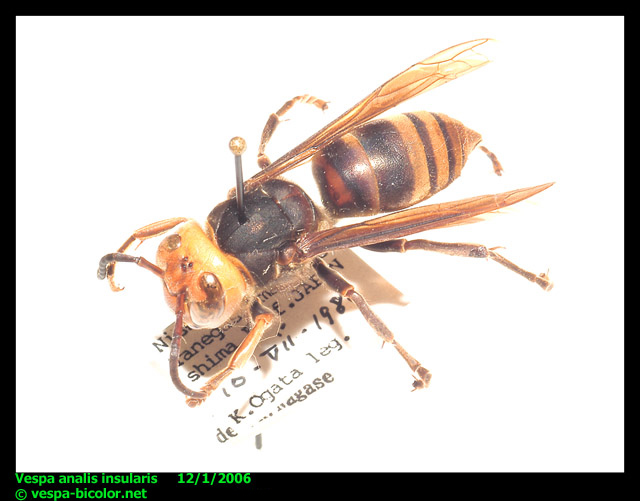
A medium-sized to large hornet, worker specimens in my collection from various regions generally range between 20 and 30mm, although I have seen some truly enormous specimens in Singapore. This species is extremely variable in colour and pattern throughout its range. Southeast Asian specimens are usually mainly black with only the tip of the abdomen (the sixth segment) yellow. The most common form in Singapore is slightly lighter, with a red or brown head and pronotum and some red and yellow markings on the abdomen, although I have also seen the completely black form. Specimens from sub-tropical, mountainous or temperate areas have yellow heads. In areas where they occur together with Vespa mandarinia, they tend to resemble the colour form of Vespa mandarinia found in the same place. The three specimens below are, in respective order, typical Vespa analis from Southeast Asia, Vespa analis parallela from Russia and Vespa analis insularis from Japan.
This was the most common colour form I found in Singapore.

This species is one of the most widely distributed hornets. It can be found in temperate areas such as Japan, Russia and Korea, and is also found over much of China and Taiwan, down to tropical regions like Singapore and Indonesia.
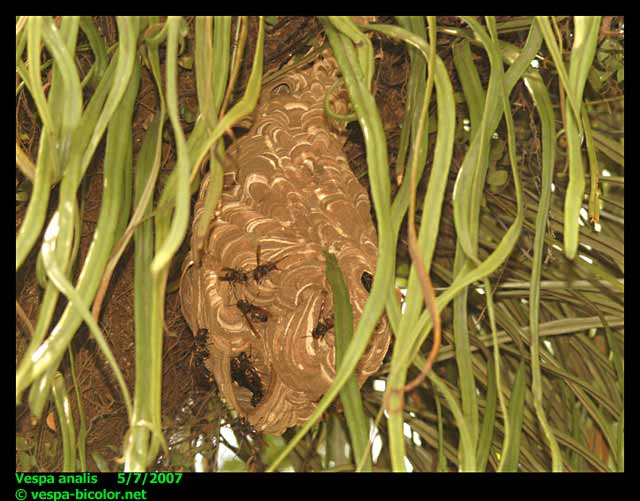
Vespa analis is a typical tree-dwelling hornet. Its nests are generally built from six to ten feet above ground, lower than those of Vespa affinis and Vespa velutina. The nest envelope is usually quite dark and sturdy, and has a coarsely imbricate pattern, with large, obvious overlapping circular sections. In temperate areas, the nest gets only very slightly oval, and the colony size is generally not very large. However, nests in the tropics reach substantial sizes. There is also the same variation seen in nests of Vespa affinis; nests in tropical regions are tapered from the top and get wider further down.
This species is in fact very common in Singapore, but I only managed to see individuals after quite a long, hard search. After observing it in the field for some time, I now realize the reason behind it being so elusive and thus causing me to erroneously consider it rare. Vespa analis appears to be a very secretive, shy species. It seldom lands to feed on anything, except coconut flowers which are often at considerable heights. Unlike Vespa affinis, which flies boldly around grass and forages everywhere in search of food, many of my sightings of Vespa analis were confined to it darting out from bushes or disappearing into them. Even tracking down an active colony proved greatly challenging and it took me six weeks to locate the nest! The reason being that the wasps took a long detour through a thick cluster of ornamental trees, misleading me into searching for the nest among these trees! Eventually I found out that the nest was on a larger tree nearby, but instead of flying directly to the nest as many other species would have done, these hornets were flying through the thick cluster of trees on their way back and forth! A deliberately evolved means of confusing predators and preventing the nest from being discovered, or pure coincidence? I don't rule this possibility out, because almost everything about Vespa analis I have observed so far suggests shyness and a timid nature. The colony which took six weeks to track down is shown below; this is a typical nest of Vespa analis, already of quite a substantial size but still capable of getting bigger. The other photo shows a large, probably abandoned, nest. Although the possibility of it belonging to Vespa affinis cannot be ruled out, it is more likely a nest of this species, due to the characteristic markings.

Vespa analis is also present in Hong Kong. I have seen specimens in quite a wide range of locations in the New Territories and a few locations on Hong Kong Island. Although not exactly limited in range, it is uncommon in Hong Kong, unlike in Singapore, and with the same shyness and habit of flying close to vegetation and disappearing into the foliage when sighted, it is even harder to find in Hong Kong. It appears to have a fairly long colony cycle and I have witnessed workers attempting to catch butterflies in early January, which indicates that some nests might still have brood or new queens then. I have never seen a confirmed nest in Hong Kong, although I have seen photographs taken by hikers, deep in the countryside, built in small trees about six to ten feet (approximately two to three metres) off the ground, which appear to have been built by this species (all such photos were taken and shown to me when the colony had obviously died off).
There are in fact two colour forms of Vespa analis in Hong Kong. The photo below shows the more common form, which somewhat resembles Vespa mandarinia in appearance.

For more detailed information on this species and the giant hornet Vespa mandarinia in Hong Kong, you may refer to this paper I wrote and published under the Hong Kong Entomological Bulletin (published by the Hong Kong Entomological Society) Click here (link opens in new window)
Apart from attempting to catch butterflies, I have observed workers in Singapore catching honeybees around flowers and chasing dragonflies, just as Vespa affinis often does. However, I have not seen it scavenging on dead animals or food left behind by people, as Vespa affinis often does.
This species is generally considered to be one of the least defensive species. However, in Japan, it is responsible for quite a number of attacks, due to its abundance and its fondness for building near human habitation.